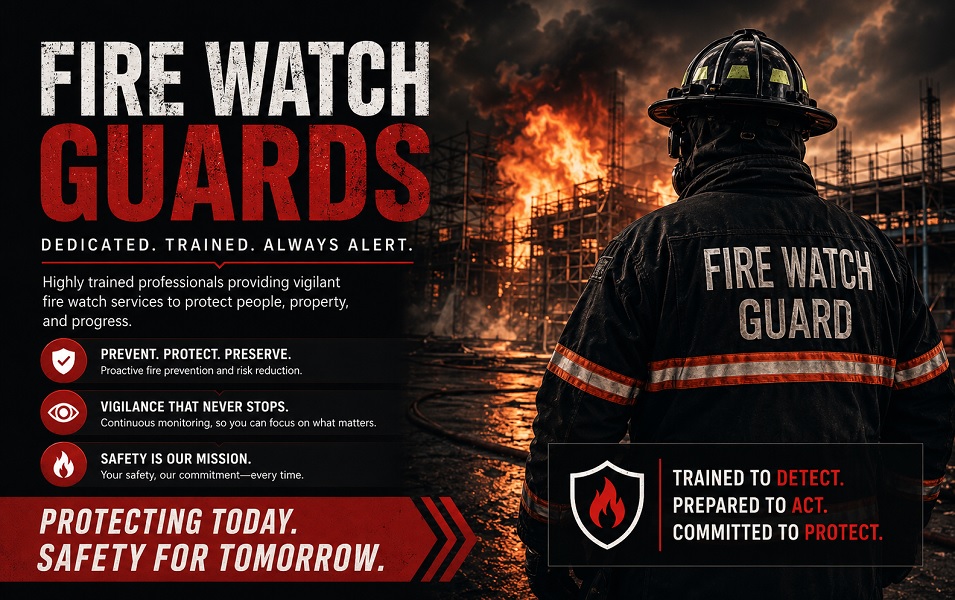
There’s a moment — quiet, unremarkable — when a smoldering ember finds the right conditions to become something catastrophic. Most people never think about that moment until it’s too late. But some professionals think about nothing else. Fire Watch Guards stand at that precise intersection of vigilance and prevention, doing work that most businesses overlook until the stakes become unbearably high.
The fire safety industry is undergoing a quiet revolution. As urban construction booms, older buildings age out of compliance, and fire suppression systems face increased demand, the role of trained fire watch personnel has evolved from a regulatory checkbox into a mission-critical business function.
When Sprinklers Go Offline, Everything Changes
Every commercial building, hospital, warehouse, and high-rise has one thing in common: a moment of vulnerability. Fire suppression systems go offline for maintenance, malfunction unexpectedly, or simply haven’t been installed yet in a structure mid-construction. During that window — which can last hours, days, or even weeks — a facility is legally and physically exposed.
This is where the gap between assumption and reality becomes dangerous. Many facility managers assume that shutting down a sprinkler system for routine inspection is a low-risk administrative task. Insurance carriers, fire marshals, and federal safety codes disagree.
OSHA regulations and the National Fire Protection Association (NFPA) 101 Life Safety Code mandate that when fire suppression or detection systems are impaired, a trained fire watch must be deployed. This isn’t a suggestion buried in a footnote — it’s an enforceable requirement with real consequences for non-compliance, including fines, permit revocations, and in worst-case scenarios, criminal liability after a fire event.
The Human Element That Technology Can’t Replace
We live in an era of smart sensors, AI-powered detection systems, and IoT-connected fire panels. The instinct is to assume that human patrols are a relic of an older, less sophisticated era. That assumption is both understandable and dangerously wrong.
Technology detects. Humans interpret, adapt, and respond with judgment.
A seasoned fire watch professional walking a construction site at 2 a.m. notices a propane tank left too close to a welding station. A sensor doesn’t. A guard patrolling a hospital corridor during a suppression system test catches a kitchen worker leaving a gas range unattended. An algorithm doesn’t flag that. These aren’t hypotheticals — they’re the kinds of scenarios that fire watch personnel encounter routinely, and they represent the irreplaceable value of human situational awareness.
There’s also the behavioral dimension. When workers, contractors, and building occupants know that trained fire watch personnel are physically present, behavior shifts. Shortcuts get skipped. Safety protocols get followed with more rigor. The mere presence of a professional creates accountability that no digital system can fully replicate.
Construction Sites: The Highest-Stakes Environment
If there’s one environment where fire risk is both elevated and frequently underestimated, it’s active construction. Welding, cutting, grinding, temporary electrical systems, combustible materials stacked in unfinished spaces — construction sites are, by their nature, controlled chaos.
The U.S. Fire Administration has consistently identified construction and demolition sites as among the most fire-vulnerable environments in the country. Yet fire safety at these sites often gets treated as a secondary concern, subordinate to deadlines, budgets, and contractor schedules.
The cost of that trade-off can be staggering. A single fire on an active construction project can destroy months of work, trigger insurance disputes, delay occupancy permits, and expose general contractors to multimillion-dollar liability claims. Against that backdrop, the cost of deploying fire watch guards on a construction site doesn’t look like an expense — it looks like the most rational risk management decision a project manager can make.
Forward-thinking construction firms have already internalized this calculus. They’re building fire watch coverage into their project plans from day one, treating it with the same seriousness as structural inspections and environmental compliance.
What Separates Trained Fire Watch Personnel from a Security Guard with a Flashlight
This distinction matters more than most people realize. Fire watch is a specialized discipline. It’s not a function that can be absorbed by a general security presence and executed effectively.
Trained fire watch professionals understand the specific fire hazards associated with different occupancy types — whether it’s a chemical storage facility, a data center, a live entertainment venue, or a healthcare campus. They know how to conduct systematic patrols, document their rounds properly, communicate with fire departments, and make the split-second decision between attempting to suppress a small fire and initiating evacuation protocols.
That last point deserves particular emphasis. In a genuine fire event, improper decision-making in the first 90 seconds can be the difference between a contained incident and a structural catastrophe. Fire watch personnel train for that 90-second window. They understand fire behavior, suppression limitations, and the non-negotiable priority of life safety over property protection.
Proper documentation also plays a role that extends well beyond the immediate safety function. When a fire watch log is maintained accurately, it becomes a legal record that demonstrates regulatory compliance, supports insurance claims, and can protect a business from litigation in the aftermath of an incident.
Industries That Can’t Afford to Overlook This
While fire watch coverage is relevant across virtually every commercial sector, certain industries face exposure that makes this service not just advisable but existential.
Healthcare facilities operate with patients who cannot self-evacuate. A lapse in fire safety coverage during suppression system impairment isn’t just a regulatory violation — it’s a direct threat to lives that a hospital has a legal and ethical obligation to protect.
Data centers house infrastructure that powers global commerce. A fire event in a data center doesn’t just damage hardware — it can erase financial records, disrupt payment systems, and trigger cascading failures across industries. The cost of deploying fire watch personnel for 72 hours during a suppression system upgrade is negligible compared to the recovery cost of a single data loss event.
Live event venues present a unique challenge — high occupant density, temporary infrastructure, and variable floor layouts that change from event to event. Fire watch coverage at concerts, conferences, and sporting events isn’t just about detecting fire. It’s about managing the human dynamics of panic and evacuation in spaces that may hold thousands of people.
For each of these industries, fire watch isn’t a peripheral service — it’s a core operational safeguard.
The Regulatory Pressure Is Only Increasing
Across the United States, fire safety enforcement has been trending toward greater scrutiny, not less. Municipal fire marshals are conducting more frequent inspections. Insurance underwriters are requiring documented fire watch coverage as a condition of coverage for high-risk occupancies. State-level building codes are being updated to align with the latest NFPA standards, which in many cases expand the scenarios that trigger mandatory fire watch requirements.
This regulatory momentum reflects a broader shift in how commercial property risk is being assessed. Investors, lenders, and insurers are no longer willing to treat fire safety as a passive feature of a building’s infrastructure. They want evidence of active risk management — documented, auditable, and professionally executed.
Businesses that proactively adopt robust fire watch protocols aren’t just avoiding penalties. They’re building a compliance posture that makes them more insurable, more financeable, and more attractive to institutional partners who take operational risk seriously.
Choosing the Right Fire Watch Partner
The market for fire watch services is fragmented. There are firms that specialize exclusively in this discipline, and there are general security companies that offer fire watch as an add-on service without the depth of training or operational protocols that the work demands.
When evaluating a fire watch provider, the questions that matter most aren’t about price per hour. They’re about training standards, patrol documentation practices, communication protocols with local fire departments, and the company’s track record in high-complexity environments.
Providers like Just Fire Watch have built their entire operational model around this specialization — bringing purpose-built expertise to a function that too many businesses have historically treated as a commodity.
The right fire watch partner understands that they’re not just providing a body in a building. They’re providing peace of mind backed by professional competence. That distinction shows up most clearly not in normal operations, but in the moments when something actually goes wrong.
The Cost of Complacency Has Never Been Higher
There’s a persistent myth in commercial risk management — that fire events are rare enough to be treated as low-probability concerns that don’t justify proactive investment. The data tells a different story. The NFPA estimates that U.S. fire departments respond to roughly 100,000 non-residential structure fires annually, causing billions in direct property damage and immeasurable disruption to business operations.
Behind every one of those statistics is a business that believed, right up until the moment the smoke began to rise, that a fire wasn’t going to happen to them.
Fire watch guards represent one of the most direct, cost-effective interventions available to any business that wants to close the gap between assumption and reality. Their value isn’t theoretical — it’s demonstrated every shift, in every building, every time a trained professional catches something that a sensor missed, that a camera didn’t capture, and that an untrained eye would have walked right past.
The question isn’t whether your business can afford professional fire watch coverage. The question is whether you’ve accurately calculated the cost of going without it.
Leave a Reply